
Forklift Safety
9 Strategies To Prioritize Forklift Pedestrian Safety
Jan
Warehouses must ensure everyone is safe in and outside the workplace. While walking from one area to another, workers may not pay attention to where they’re going, so they need to learn how to walk safely when near heavy material equipment. Here are key strategies to prioritize forklift pedestrian safety. Implementing effective strategies to prioritize forklift pedestrian safety is essential for a secure work environment.
Yield to Pedestrians
Effective Strategies To Prioritize Forklift Pedestrian Safety
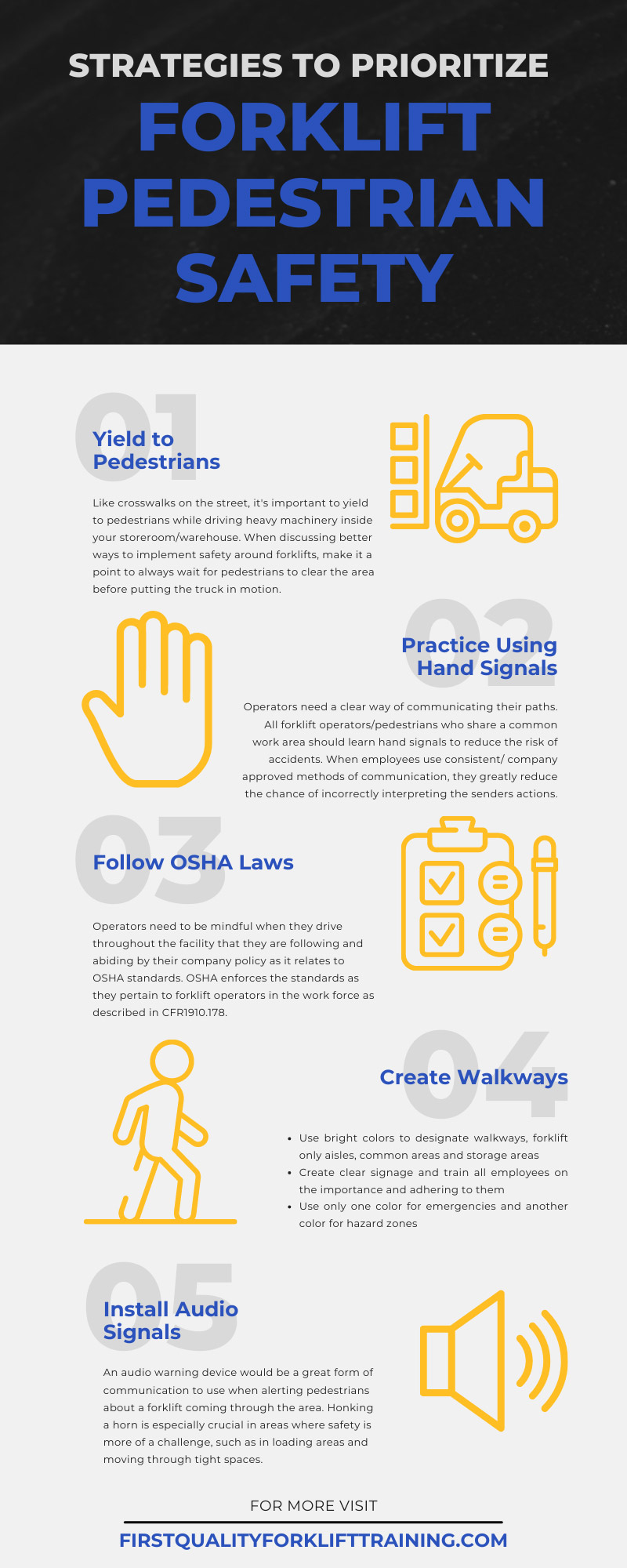
Like crosswalks on the street, it’s important to yield to pedestrians while driving heavy machinery inside your storeroom/warehouse. When discussing better ways to implement safety around forklifts, make it a point to always wait for pedestrians to clear the area before putting the truck in motion.
Another crucial aspect of strategies to prioritize forklift pedestrian safety is to ensure that all employees are trained on the importance of safety awareness.
By yielding, you make your employees more aware of the machinery. Workers will act with caution and wait for others to move before going.
Practice Using Hand Signals
These practices are part of the broader framework of strategies to prioritize forklift pedestrian safety, creating a safer environment for all.
There are many ways to create alerts for pedestrians and forklift operators. While working, both the pedestrian and driver can use hand signals to signify which direction they’re turning, stopping, or going. Sometimes, drivers may use hand signals to show if they have a large load. This tells the pedestrians to get out of the way for wider turns.
Operators need a clear way of communicating their paths. All forklift operators/pedestrians sharing a common work area should learn hand signals to reduce the risk of accidents. When employees use consistent/ company approved methods of communication, they greatly reduce the chance of incorrectly interpreting the sender’s actions. Note: The operator must only respond to signals from the designated signaler.
Move With Caution
It’s not encouraged to walk between forklifts, especially if they are in use. Pedestrians should be kept at least 4 feet away from a forklift. This cushion of safety protects the worker if the forklift makes a sudden or unprojected move Workers on foot need to realize that people lifting and transporting material might not see them.
Promoting awareness of these strategies to prioritize forklift pedestrian safety can prevent accidents.
During team meetings, work together with your employees to develop better ways to drive the vehicles with caution.
When drawing out plans, think about streets you drive on each day to get to work. Those have signs to signify which direction you can go and lights that show when it’s OK to cross the street. The same can be applied here. However, pedestrians still need to look both ways.
Incorporating strategies to prioritize forklift pedestrian safety into daily routines is vital.
It’s important to continue talking about safety for pedestrians and operators. Both must be vigilant when working on the floor.
Follow OSHA Laws
Moreover, there are industry standards and strategies to prioritize forklift pedestrian safety that all operators must follow.
Operators need to be mindful when they drive throughout the facility that they are following and abiding to their company policy as it relates to OSHA standards. OSHA enforces the standards as they pertain to forklift operators in the work force as described in CFR1910.178
Without these laws/regulations, more accidents would occur. Have your company rules posted around the warehouse i.e. safety posters/signs to give drivers brief reminders about the operating rules, like with speed limits.
Company policies should include comprehensive strategies to prioritize forklift pedestrian safety, emphasizing their importance.
Some other rules to follow and include in your training sessions include:
- Wear your seatbelt,
- Always move or avoid debris from your path of travel.
- Follow your operator manual instructions.
Improve Visibility
There might be blind spots you haven’t noticed, or maybe the ramps don’t provide enough visibility before going in and out of the loading docks. Regardless of the issues, it’s key to improve the areas that struggle with providing the best visibility.
When working with the floor plan, try placing mirrors around these problem areas and signage to alert workers of sites that are hard to see. Additionally, placing signs up near entrances and exits can warn pedestrians to stay clear of the area when forklifts are passing through.
Create Walkways
Some workers struggle to understand where to walk so that they’re not in the way of a lift. Without marked walkways, you run the risk of accidents happening. There are clear rules from OSHA that say, to stay out of the way of operators, permanent pathways are essential for workers.
Using tape or paint can help workers know what lane to walk or drive in in the warehouse. To improve the walkways more, follow these tips:
- Use bright colors to designate walkways, forklift-only aisles, common areas, and storage areas.
- Create clear signage and train all employees on the importance and adhering to them.
- Use only one color for emergencies and another color for hazard zones.
Install Audio Signals
Audio signals serve as vital tools in the strategies to prioritize forklift pedestrian safety.
Hand signals can only go so far until they become lost in translation. It’s best to have a company policy/training program that fosters consistent and clearly defined forms of communication.
Adding an audio warning device would be a great form of communication to use when alerting nearby pedestrians of a forklift coming through the area. Honking a horn is especially crucial in areas where safety is more of a challenge, such as in loading areas and moving through tight spaces.
When speaking with your crew, come together to discuss which parts of the building they feel less safe and develop different ways to fix the issues.
Other methods of communication you should consider when trying to improve the warehouse communication include creating safety words and having safety zones in place for workers to move to.
Maintain Your Equipment
The most important thing you can do to provide better safety is perform maintenance checks. Those who operate lifts need to perform checks to ensure everything is in working condition and file reports on any damaged pieces. Additionally, no one should use a forklift if it’s in need of repair.
Regular maintenance is part of the overall strategies to prioritize forklift pedestrian safety that should never be overlooked.
Always perform a maintenance check before driving. This check includes items such as: the condition of the tires, ensuring the parking brake functions, and no hydraulic leaks (see operator manual for complete list).
Use the Correct Tools
Using the correct tools is essential in the strategies to prioritize forklift pedestrian safety that can enhance workplace safety.
Not every forklift uses the same tools. Each one is different and comes with its own accessories to help improve workplace ergonomics.
Have your forklift operators learn their lift’s class proper use and limitations. Require performing pre-checks so that they can safely and properly operate their lift. Keep working with your staff on developing strategies to prioritize forklift pedestrian safety.
Fostering a culture around strategies to prioritize forklift pedestrian safety can significantly reduce incidents.
Every pedestrian and forklift operator must know how to stay safe while working in the same proximity. You and your fleet can discover more about forklift operation safety through a forklift training package.
By providing training, companies can ensure that employees understand the strategies to prioritize forklift pedestrian safety.
The training programs give workers the opportunity to learn about the forklift in-depth. They will learn about forklift classes, how to conduct pre-checks, and how they can receive their certification.
It’s important to establish strategies to improve forklift safety. Not only should safety be a priority, but so is efficiently operating a forklift. Keep the education going with an education kit from First Quality Forklift Training. Contact us here for more information on how you can improve safety in the warehouse and how our programs can help train your employees.
Continued education and awareness are key components of effective strategies to prioritize forklift pedestrian safety.
Ultimately, implementing these strategies to prioritize forklift pedestrian safety will lead to a safer workplace.
