
Forklift Safety
What To Expect on a Forklift Inspection Checklist
Jun
What To Expect on a Forklift Inspection Checklist: Why Daily Forklift Inspections Are Important
Workplaces where forklifts operate must follow strict OSHA guidelines to remain safe and reputable. “OSHA requires that Industrial trucks shall be examined before being placed in service, and shall not be placed in service if the examination shows any condition adversely affecting the safety of the vehicle. Such examination shall be made at least daily. Where industrial trucks are used on an around-the-clock basis, they shall be examined after each shift. Defects, when found, shall be immediately reported and corrected” (1910.179(q)(7))
Operators should be trained on what to expect on a forklift inspection checklist to ensure compliance with regulations.
For the highest level of care and accuracy, operators should know what to expect on a forklift inspection checklist. Read through the list below to determine whether your workplace is following the proper OSHA-compliant inspection guidelines or not. If you ever see a forklift operator ignoring the steps below, don’t allow their recklessness to flourish—enforce the proper forklift operator practices at all times, even before the forklift is operational.
It’s essential for operators to know what to expect on a forklift inspection checklist to maintain safety and compliance.
Pre-Operation Inspection
Understanding what to expect on a forklift inspection checklist is critical for maintaining safe operational practices.
Forklift inspections feature two phases: pre-operation and operational. Let’s start by detailing the first phase operators will encounter: pre-operation.
Familiarity with what to expect on a forklift inspection checklist helps ensure that all safety measures are adhered to.
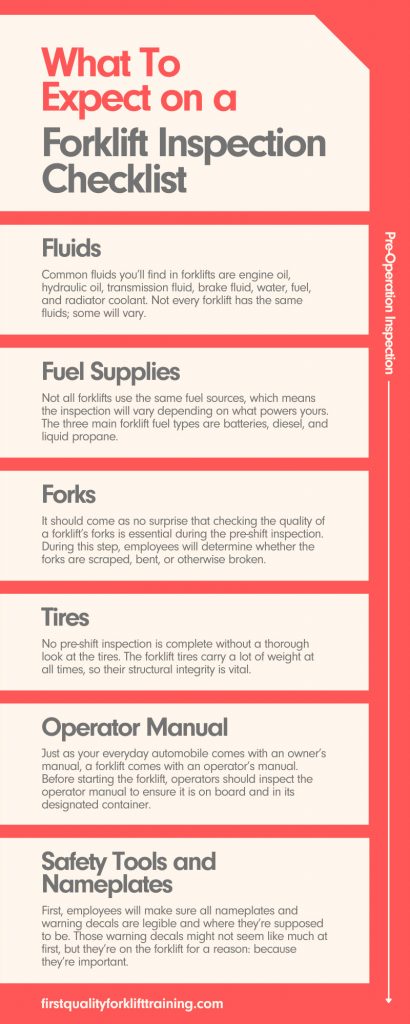
Fluids
Common fluids you’ll find in forklifts are engine oil, hydraulic oil, transmission fluid, brake fluid, water, fuel, and radiator coolant. Not every forklift has the same fluids; some will vary. For instance, electric forklifts are battery-powered, meaning they don’t have engine oil to check.
As part of their daily pre-shift inspection, forklift operators must inspect any and all fluid levels to ensure they’re sufficient for functioning in the workplace. Furthermore, employees must inspect the forklift for any signs of leaking. Fluid leaks aren’t just bad for the forklift but also present a significant health hazard in the workplace.
Fuel Supplies
Not all forklifts use the same fuel sources, which means the inspection will vary depending on what powers yours. The three main forklift fuel types are batteries, diesel, and liquid propane. Below, we’ll detail how to inspect each of these fuel types.
Knowing what to expect on a forklift inspection checklist allows operators to prepare effectively for their shifts.
Battery-Powered Forklifts
As mentioned earlier, electric forklifts are battery-powered, so operators will have to inspect the battery restraints, electrolyte levels, hood latch, and all cables or connectors associated with the battery. During inspections, safety is key—employees must always wear the proper PPE (face shield, rubber gloves, etc.) when checking a forklift’s electrolyte level.
During inspections, it’s important for operators to understand what to expect on a forklift inspection checklist to ensure each component is checked thoroughly.
Internal Combustion Forklifts (Diesel)
Internal combustion engines are very different from batteries but inspecting these two power supplies isn’t drastically different. We’ve already discussed the various fluids in forklifts, and the levels you’ll need to check for IC engines are brake fluid, engine oil, and engine coolant levels. Furthermore, this step of the inspection requires checking out the radiator, air filter, fuel sedimentor, hood latch, and all belts or hoses. If any components require cleaning, repairs, or replacements, they must occur immediately.
Liquid Propane Forklifts
As with battery-powered forklifts, inspecting liquid propane tanks requires PPE, including but not limited to a face shield and a pair of gauntlet gloves. Once an operator dons the proper PPE, they can begin inspecting the propane tank’s restraints, hoses, and connectors. Look for any dents, punctures, leaks, and other serious signs of damage. Operators will also take note of whether the tank is securely installed onto the forklift. Lastly, a propane tank inspection calls for checking the position of the pressure relief valve, which should be pointing up.
Operators should always be aware of what to expect on a forklift inspection checklist, especially when handling liquid propane forklifts.
Forks
It should come as no surprise that checking the quality of a forklift’s forks is essential during the pre-shift inspection. During this step, employees will determine whether the forks are scraped, bent, or otherwise broken. Forks must be free of excessive damage to transport materials safely and securely. Additionally, operators must always inspect the top clip retaining pin and heel before deeming the forks functional.
Next, operators must ensure some components are securely attached, 100 percent functional, and free of damage. These include the load backrest, overhead guard, finger guards, mast chains, and hydraulic hoses. At this stage, employees only worry about damage and attachments; we’ll get into the details of testing functionality later on in this guide.
Tires
No pre-shift inspection is complete without a thorough look at the tires. The forklift tires carry a lot of weight at all times, so their structural integrity is vital. Employees must conduct a visual inspection to find any signs of damage, such as cuts or gauges. If employees spot no signs of damage, the next point on their checklist—providing the forklift has pneumatic tires—would be checking the tire pressure. Note: if you notice any missing or loose lug nuts (pneumatic tires), have the tires serviced by a properly trained mechanic. Air pressure in the tires can cause the tire and wheel parts to explode, causing serious injury or death. Pneumatic tires and wheels must be changed and repaired only by trained service persons.
A comprehensive look at tires is part of what to expect on a forklift inspection checklist, ensuring all components are safe and functional.
Operator Manual
Just as your everyday automobile comes with an owner’s manual, a forklift comes with an operator’s manual. Before starting the forklift, operators should inspect the operator manual to ensure it is on board and in its designated container. Furthermore, operators must determine the manual is readable and the container is free of debris. A forklift operator’s manual is invaluable, so a thorough inspection of it and its compartment should be as high on your priority list as any other step on this guide.
Reviewing what to expect on a forklift inspection checklist regarding the operator manual is crucial for safe operations.
Safety Tools and Nameplates
First, employees will make sure all nameplates and warning decals are legible and where they’re supposed to be. Those warning decals might not seem like much at first, but they’re on the forklift for a reason: because they’re important. Besides the decals, there are several safety tools operators have to inspect before starting the forklift—the seatbelt or any other fall protection gear on the vehicle. If these devices are functional, operators can move on to the next box on their checklist.
Operational
Understanding what to expect on a forklift inspection checklist can help operators identify potential issues before they become serious.
Now you know what to expect to find on a pre-operation forklift inspection checklist. Once the pre-inspection phase is complete, operators can fire up the forklift and begin the operational inspection, the steps for which you can find below.
Confirming Functionality
Most of the operational inspection is checking the functionality of the various components on a forklift. Specifically, employees will test the accelerator linkage, parking brake, service brake, steering, drive control, tilt control, hoist and lowering control, hour meter, horn, lights, and attachment controls. If the forklift has any alarms, employees should test those too. When testing drive and tilt control, employees must confirm backward and forward functionality.
Strange Noises and Vibrations
Operators should be alert to what to expect on a forklift inspection checklist, especially when it comes to strange noises or vibrations during operations.
Functionality isn’t the only thing to monitor during the operational inspection. While testing out the forklift controls, operators must be on the lookout for any strange noises or vibrations. Even if a certain component is seemingly working fine, any abnormal sounds or vibrations should be immediately noted and addressed.
After reading this guide, you should have a better view of what to expect on a forklift inspection checklist. Following the forklift manufactures inspection checklist won’t only confirm the vehicle is operational but also that it isn’t a safety hazard in your workplace.
In conclusion, appreciating what to expect on a forklift inspection checklist is vital for ensuring workplace safety.
OSHA Forklift Training & Certification
If you’re in charge of any forklift operators, make sure the steps clearly listed above are on their inspection checklist. Furthermore, make sure those operators follow the manufactures checklist closely (because they should be). Don’t forget to provide new employees with resources such as an OSHA forklift training video to ensure they’re following the proper industry guidelines after completing their initial inspection.
Make sure your team understands what to expect on a forklift inspection checklist to enhance overall safety compliance.
To learn more on the importance of performing a pre-operation inspection, check out the article What To Expect on a Forklift Inspection Checklist: Why Daily Forklift Inspections Are Important

Great overview! I like how this article explains what operators should expect on a forklift inspection checklist, from pre-operation checks like fluids, forks, tires, and safety equipment to operational tests such as brakes, steering, and controls. It’s a good reminder that taking a few minutes to inspect the truck each shift can prevent accidents and keep equipment running safely. Very practical and informative!